Queer Places:
Yale University (Ivy League), 38 Hillhouse Ave, New Haven, CT 06520
Grove Street Cemetery, New Haven, New Haven County, Connecticut, USA
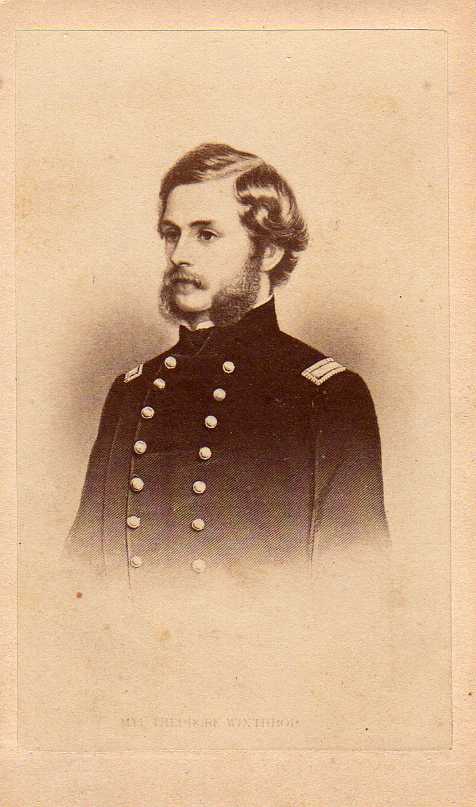 Theodore Woolsey Winthrop V (September 22, 1828 - June 10, 1861) was born on September 22, 1828, in New Haven, Connecticut. He was born into a prominent New England
family—his parents were Francis Bayard Winthrop Jr. (1787–1841) and Elizabeth Woolsey Winthrop (1794–1863).
Theodore Woolsey Winthrop V (September 22, 1828 - June 10, 1861) was born on September 22, 1828, in New Haven, Connecticut. He was born into a prominent New England
family—his parents were Francis Bayard Winthrop Jr. (1787–1841) and Elizabeth Woolsey Winthrop (1794–1863).
A member of the Yale Class of 1848, Winthrop was a gifted writer, traveler, and intellectual. Following his graduation, he traveled extensively across Europe and the
American West, experiences that heavily influenced his literary work.
Following the outbreak of the American Civil War, Winthrop mustered into service on April 26, 1861, joining the 7th New York Militia Regiment. He quickly gained literary
recognition during this period by penning a popular account titled "March to Washington" for the June 1861 edition of The Atlantic Monthly.
Winthrop was killed at the Battle of Big Bethel in Virginia on June 10, 1861, at the age of 32. He is widely recognized as one of the very first Union officers killed in
action during the war.
At the time of his death, he wore the gray uniform of the 7th Regiment of New York, in which he was initially buried before his body was returned home.
Received in New Haven with full military honors, his funeral procession was led by Yale students and citizens. Professor Noah Porter (later President of Yale) delivered
the address.
Honoring a wish he once expressed to his mother—"When I die, put a granite cross over my grave"—a granite cross designed by architect Richard Upjohn was erected over his
burial spot in Grove Street Cemetery, New Haven. The cross was sculpted with an "endless cord" as an emblem of eternity, bearing only his name and the date/place of his
death.
Although Winthrop had limited literary success during his lifetime, his novels were published posthumously to great acclaim, rapidly running through multiple editions in
the 1860s. Modern literary scholars and LGBTQ historians frequently analyze his writings—particularly Cecil Dreeme (1861) and John Brent (1862)—for their depiction of
intense male intimacy, homosocial bonds, and proto-queer themes.
In works like John Brent and Cecil Dreeme, Winthrop explores deep, passionate male-male bonds that early-to-mid 19th-century society celebrated as "romantic friendship"
or "manly love," written prior to modern taxonomies of sexual identity.
Cecil Dreeme (1861) is often described by modern scholars (such as Peter Coviello and Christopher Looby) as one of the "queerest" American novels of the 19th century.
The plot follows protagonist Robert Byng, who forms a passionate, soul-bound attachment to a reclusive young painter named Cecil Dreeme.
Concurrently, Byng struggles against the magnetic, dark allure of a villainous character named Densdeth—a dynamic scholars interpret as an allegory for competing forms of
male attraction and moral purity.
Although Dreeme is revealed at the story's end to be a woman hiding in cross-dressed disguise, the emotional core throughout the narrative remains explicitly focused on
male-male devotion, romantic attraction, and same-sex desire.
Historians (such as Matthew Busick in "Becoming a Yale Man: Intimacy among Yale Students in the Nineteenth Century") point to Winthrop's background at Yale to
contextualize how 19th-century collegiate homosocial spaces fostered intense emotional and romantic bonds among young men.
References:
- Newspaper Article: The Richmond "Daily Dispatch" (June 13, 1861)
- Periodical Article: Theodore Winthrop, "March to Washington," published in The Atlantic Monthly (June 1861
- Archival Collection / Regional History: New Haven Register (Section B, Page 5)
- Memoir / Posthumous Biographical Sketch
- Burial Record: Find a Grave / Genealogical Record for MAJ Theodore Woolsey Winthrop V (1828–1861), Grove Street Cemetery, New Haven, New Haven County, Connecticut
- Winthrop, Theodore. Cecil Dreeme (1861)
- Winthrop, Theodore. John Brent (1862)
- Busick, Matthew, "Becoming a Yale Man: Intimacy among Yale Students in the Nineteenth Century" (MSSA Kaplan Prize, Yale University, 2007)
- Substack Article / Essay: Olinger, Ted, "The Canoe and the Saddle: A 19th-Century..." (https://tedolinger.substack.com/p/the-canoe-and-the-saddle-a-19th-century)
Support this project
This website is a passion project researched, developed, and funded entirely by me. If you find the content valuable and would like to help support the ongoing research and hosting costs, any contribution is deeply appreciated.
Thank you for keeping this independent resource alive!
My books on Amazon: Elisa Rolle's books
BACK TO HOME PAGE